“Food Not Fear”
Tenth Sunday after Pentecost
August 2, 2026
Philippians 3:12-16
Matthew 14:13-21
Frederick Buechner once said, “Greed is the mathematical truism that the more you get, the more you have. The opposite of greed—the selfless love of God and neighbor—is based on the truth that the more you give away in love, the more you are.” The more you give in love, the more you ARE.
Let’s take a look at today’s story and its context. First, poverty was a huge problem in first century Israel—not unlike today across the world. Many people were homeless and hungry. While the rich got richer, the poor got poorer. And though it starts to sound a lot like things today, the difference is that in Jesus’ day, there were no programs to help the downtrodden and hopeless. There was no SNAP and Medicaid and disability insurance. So, it’s highly possible that those who followed Jesus not only didn’t have homes to go back to; they may also not have had money to go into the towns to buy food for themselves. They are people that went in search of hope—and found it in Jesus.
When Jesus had heard about John the Baptist’s murder, he went to a quiet place to be alone. Then, the passage says “the crowds heard of this and followed.” It’s not clear whether that refers to hearing about Jesus going off by himself or hearing about John’s beheading. Perhaps they had been following John in search of hope and new life. When they heard about his death, they moved on to the one he baptized. Like lost sheep looking for a shepherd, they gravitated to those who weren’t satisfied by what the government was doing but pushed for justice. They gravitated to the trouble-makers and protesters because the way things were just wasn’t cutting it.
This passage follows on the heels of John’s arrest and beheading. He was arrested in response to his challenge of Herod’s immorality and corruption. Herod had illegally married his sister-in-law. And the fact that her daughter—his niece—‘danced in such a way that deeply pleased him’ for his birthday holds its own connotations. So when he drunkenly and stupidly promised the girl anything because of her dancing, her mother suggested she ask for John’s head on a platter.
Herod was a weak and fearful man. He feared the crowds when he arrested John. He feared his guests, meaning he had to follow through with his promise. He feared Jesus, thinking that he was John resurrected and holding even more power than before. And where fear reigns, violence isn’t far behind.
Our world is filled with fear—legitimate and real fears. Fears for immigrants being deported or detained. Fears of children being abused and women being raped. Fears for trans people just wanting to use a bathroom. Fears for pregnant women who are experiencing difficulties and don’t have realistic options.
But where fear reigns, violence is close behind.
Look again at Herod. All of that fear he held—fear of being recognized as a poser, fear of being seen as weak, fear of anyone pointing a finger at him. All of that fear led to John’s death. It led to Jesus’ death. It led to far too may deaths and far too much chaos. And he still feared—he feared the people.
Imagine what he would have thought about nearly 15,000 people gathered around Jesus, seeking hope. Seeking answers. Imagine what Jesus could have done with that many people—the rebellion he could have launched. Instead, he healed. He taught. He fed. First, he fed the soul. Then, he fed the body.
Imagine the disciples looking at all of these people, wayward, longing, hungry for life. And when they commented on it, Jesus said, “You feed them.” And they looked at their meager bits of food, not even enough for themselves. They had already planned to ration, but this was ridiculous. “We have nothing here!” they cry. “We’re no better off than they are.” They were afraid—afraid of disappointing Jesus; afraid of disappointing a crowd already unhappy and uncomfortable.
And Jesus reminds them, “You have me.” “But,” they counter, “how will this work? What will we do? Think of the logistics for all of these people. And don’t forget, we have nothing here!”
It’s not the right time. It’s not the right place. We have nothing to offer. How many times have we spoken similar words in fear of what God is asking us to do? How is this going to work? Where will we get the resources? What if…what if we run out? What if someone doesn’t like what we offer? What if we can’t get to everyone? And what about us? What are WE to eat and have? And what about tomorrow? And the next day?
These are all questions of fear. And where fear reigns, violence is close behind.
Pastor Amy Frykholm talks about the ministry she helps lead in Leadville, CO. Her congregation has been serving a daily Community Meal and Food Pantry for 30 years. Most of the time, they find themselves concerned about how much they have. Is there enough food for everyone? Is there enough money to get to next month? Sometimes, donations come in in waves, actually making the distribution even more challenging.
One day, they received 100 half-gallons of ice cream from a local grocery store whose freezers had failed. The ministry didn’t have freezer space for all of the ice cream, and Amy found herself paralyzed by indecision. If she left it for anyone to take what they wanted, many would hoard the ice cream while others would get angry at not getting any. Even when it comes to simple things, we find ourselves taking more than we need for the future ‘just in case.’
She could also set a rule that each person could only take 1 tub. But she knew some households had 1 person and others had 15. That wouldn’t be fair. Finally, she got everyone’s attention and said, “Please take all the ice cream you want and none of the ice cream you don’t. There is no way that I can do that calculation for you. Only you know if you are a one half-gallon kind of person or a ten half-gallon kind of person. There is more than enough ice cream here for everyone, if everyone will just take what you actually want and leave what you don’t. And pay attention to the others around you. Think about what they might want as well as what you want.”
Then she went back to the kitchen to continue cooking the meal. Surprisingly, at the end of the day, everyone had what made sense to them, and no one complained.
When fear is removed from the equation, we can see another way. But as long as we focus on ourselves, we will continue to fear. What about us? We have nothing here. We don’t have enough for ourselves. Remember, the opposite of greed—the selfless love of God and neighbor—is based on the truth that the more you give away in love, the more you are. ‘Selfless love of God and neighbor.’
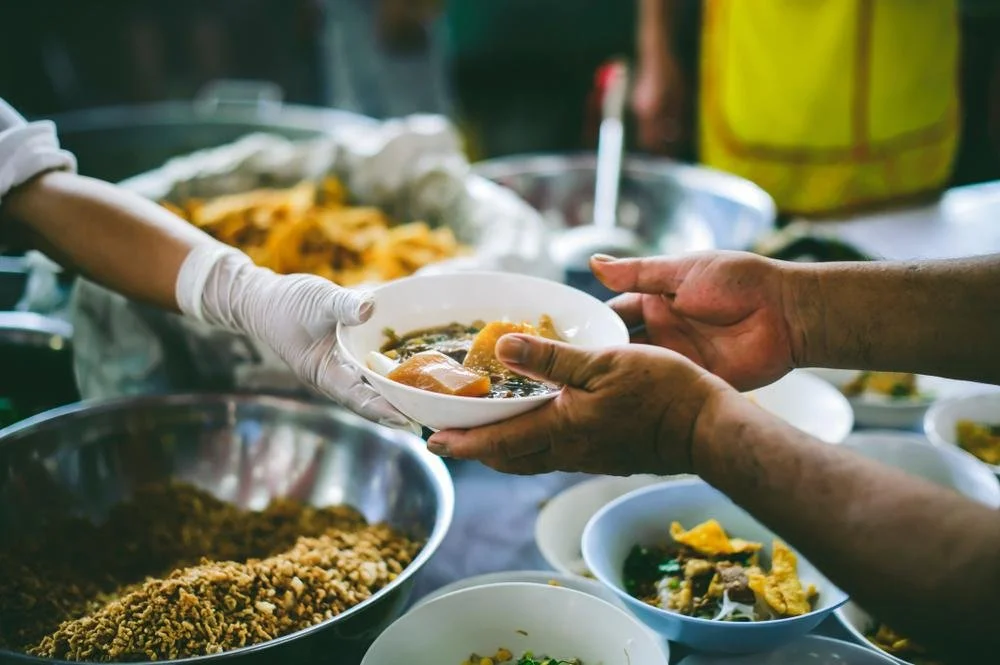
Jesus doesn’t give in on this. He doesn’t say, “Oh, I’m sorry. You’re right. They should take care of themselves. You don’t have enough. Take care of yourselves first, and give away anything YOU have left.” No. He says, “You feed them.” And then he takes the food, blesses it, breaks it, and only after the people have their fill do the disciples get to gather the leftovers. And with Jesus in charge, there is so much more left over than there was to start with.
He looked on the people with compassion. He looked on the disciples with compassion. He looks on us with compassion. And he tells us to go. Feed. Give. Let go. Trust him. Love others. For the more you give away in love, the more you are.
Pastor Tobi White
Our Saviour’s Lutheran Church
Lincoln, NE