“Crosses and Swords”
Thirteenth Sunday after Pentecost
August 23, 2026
Romans 12:1-8
Matthew 16:13-20
What assumptions would you make if I told you I’m a runner? What images does that conjure? When I think of runners, I think of marathons and speed and endurance. Which is why I don’t often describe myself as a runner. Because yesterday I struggled through 3 miles. It wasn’t pretty. At all. It definitely wasn’t fast. So, if I ever claim the label ‘runner,’ I offer the disclaimer that I’m not a great runner. Or even a good runner. But I run. Sometimes. Sort of.
We all have those labels that we hesitate to claim for ourselves. Or ones in which we feel needs a disclaimer. Whether it’s because the label has a bad connotation or because we don’t feel worthy of the label, we want to make sure people are clear about what a label means to us. When people ask what kind of Lutheran I am, I always point out that I’m the kind that ordains women, for one.
And these days, it feels necessary to clarify what kind of Christian I am. What kind of American I am. Because the assumptions in this world rarely match the reality. And I don’t want people to get the wrong idea.
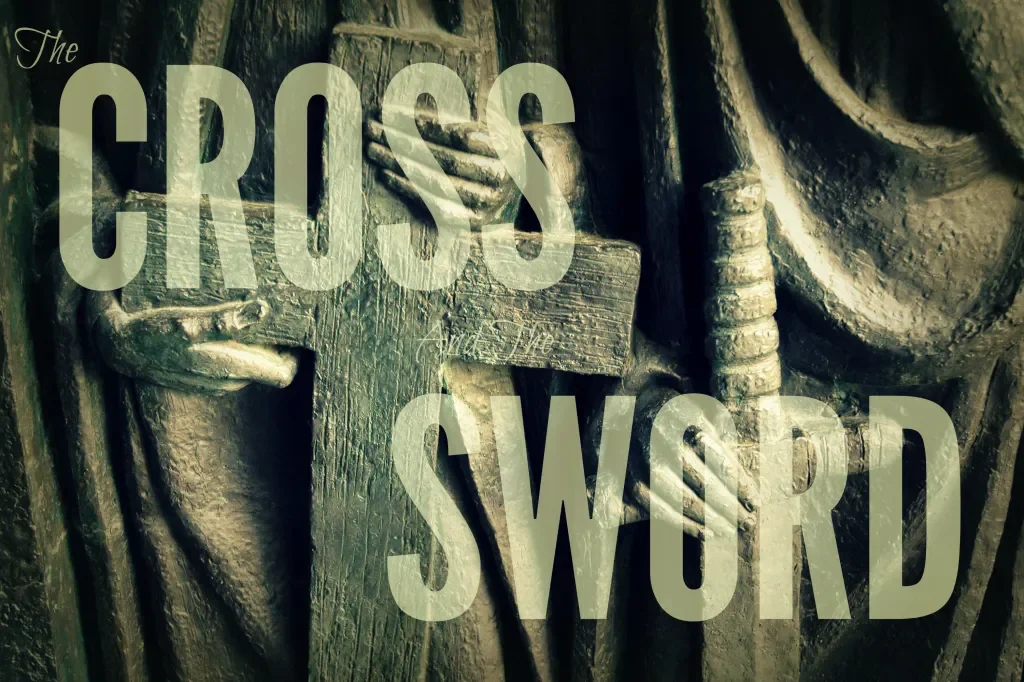
And what kind of Christian are you? There are those who will wield a sword and seek power. And there are those who will carry a cross. And honestly, most of us find ourselves bouncing around in between. But I know who I want to be. I know how I want to be. Because followers of Jesus carry a cross, not a sword.
There they stood—beyond the eyes and ears of the Temple officials—beneath the walls of stone carved out to worship the Greek god, Pan, and later named in honor of the Roman Emperor. It is here that Jesus confronts the disciples. Here—where the mythologies and religions of the world met—where Jewish influence was little more than a blip on the radar—where the phrase ‘son of god’ meant Caesar and peace was only established by the sword. Caesarea Philippi, the controversial place where Jesus asked the disciples to take a stand—right in front of the ‘gates of hell’, a cave from which the waters of the Jordan River gushed forth from the spring within.
“What are they saying about me?” he asks. As a relatively public figure, I personally think Jesus is just asking for trouble when he puts that out there. Even when we say we want to know what people are saying—we really don’t want to know. Some of my least favorite conversations start with the words, “Some people are saying…” Because ‘some people’ are generally one or two people who have an opinion but don’t want to take responsibility for it. ‘Some people’ is an unhelpful way of trying to amass an imaginary army of like-minded people as a tactic of intimidation. And yet, Jesus goes there. Jesus asks the question. “What are they saying?”
The disciples don’t hesitate. “Some people are saying you’re Elijah.” “Some people are saying you’re Jeremiah.” “Some people are saying you’re John the Baptist.” “Some people are saying…” I actually wonder if the disciples were reporting what they heard—or what they thought, themselves. The statements are relatively low-risk statements on the part of the disciples and ‘some people.’ Elijah and Jeremiah and John the Baptist are all dead by now. There’s hope behind those statements; but there’s also resignation. Because it’s possible to hear underneath the disciples’ answers a darker statement: “Some people are saying you’re a dead man.”
But then Jesus turns the question around. He’s no longer interested in what ‘some people’ are saying. He wants to know what the disciples have been saying. I imagine a great pause after that question as the disciples warily look around at one another, waiting for someone to say something. Did they really believe there might be more to Jesus than a dead prophet?
Peter finally steps forward with his answer. “You are the Messiah, the Son of the Living God.” But what does Peter mean? Because when Jesus begins to explain to Peter what will happen to the Messiah—the arrest, the humiliation, the death—Peter tries to correct him. He is still thinking of the Messiah as one who will wield a sword and win a very real, very physical battle against Rome and its emperor. He has yet to learn that followers of Jesus carry a cross, not a sword. And Peter—‘the rock’—will be called a ‘stumbling block.’
But you see, Jesus is about the business of transforming lives. Giving Simon Peter this new name isn’t just wordsmithing. This name—this word—matters. This rock and foundation matters. Paul’s letter doubles down on this, telling the church in Rome that they should not let the ways of his world—its greed, ambition, and empty promises—mold and shape them and make them like itself. Instead, they should let the gospel renew and enliven their perceptions of the world and one another. Seek every opportunity to see with new eyes, hear with new ears, try out new paths.
Paul says that we are to place ourselves into God’s hands—our mind, heart, and strength—as a sacrifice. To make ourselves an offering full of life and vitality. In this continual process of death and new life, we will eventually know how to choose the good, the true, the beautiful, and the holy. We will know how to choose the cross, not the sword. We will know how to live out our faith in a way that is life-changing. Transforming. We will know, when asked, what it means to say to the world that Jesus is the Christ, the Messiah.
Of course, we can always stay with safe answers. We can identify Jesus as a teacher, which simply means we need only agree with right doctrine to be disciples. And we can identify Jesus as a moral example—someone to follow to lead a ‘good’ life. In that case, we only need to adhere to certain ethical and moral standards to be disciples. But when no one can agree on what those standards are, battles become necessary, and winners take all.
So, what kind of Christian are you? What kind of Messiah do you follow? One that calls us to take up our cross, or one that expects us to wield a sword? Are we prepared to fight in order to win, or are we prepared to die in order to live?
And, what does that look like for us? What does it look like to willingly die as followers of Christ? I think it looks like a refusal to wield the sword, even when we’ve been wronged. It looks like denying our right to vengeance and retribution when our lives have been turned upside down. It looks like praying for the forgiveness of our enemies before we’re ready to offer it, ourselves. It looks like sitting with the poor, the oppressed, the shunned, the victimized; and sitting with the oppressors, the bullies, and the terrorists. It looks like a denial of both fear and hatred so that freedom is truly experienced. It looks like death.
And it looks like a faith that believes that the tomb will not remain closed. It looks like the dead raised in glory. It looks like the Church that is defined not by numbers or programs or doctrines. It looks like the Church that is defined by our willingness to die for one another, stand by one another, sit with one another, and serve the world—our willingness to breach the gates of hell as God leads us to a battle won by love, alone.
So, Peter makes this confession beneath the stone statues dedicated to Greek gods and Roman emperors, standing beside the ‘Gates of Hell’ which issues forth the very river in which Jesus was baptized. And Jesus calls him Rock. And on this ‘rock’—this place where the sacred and secular collide, where death and life intertwine, where hope meets despair and expectations are turned upside down—on this ‘rock’ where who we are converges with who we are called to be—this is where God establishes the Church.
I had never noticed it before, but as Jesus stands before the pagan shrines and talks about the mission of the Church, he doesn’t say that nothing will get us down. He doesn’t say that nothing will challenge us. He actually says, “And the gates of hell can’t keep us out.” You know what that means? That means we’re going in. We’re going into the world that others want to escape. We, the Church, will carry our cross and enter hell following a leader whose mission is to die. And that is where we’ll finally experience life and hope and renewal.
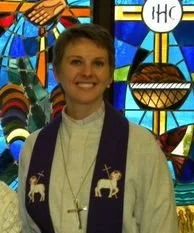
Pastor Tobi White
Our Saviour’s Lutheran Church
Lincoln, NE