
“Resurrection or Revenge”
Nineteenth Sunday after Pentecost
October 4, 2026
Isaiah 5:1-7
Matthew 21:33-46
This parable comes directly after the one we heard last week, in which Jesus seems to compare the chief priests and elders to two sons both given instructions to work in their father’s vineyard. The first one declines, but later he goes and does the work. The second one readily agrees, but never follows through.
Jesus points out to the leaders that the tax collectors and prostitutes are like the first son—changing their minds and their ways and fulfilling their responsibilities. But the religious leaders are like the second son, agreeing readily but never doing what they said they would do. And, Jesus says, those deemed immoral will be the ones leading the religious elite into God’s kindom.
But if that’s not bad enough, Jesus doubles down and uses a well-known passage from Isaiah to condemn the religious leaders even further. There was a vineyard owner who did everything to create the perfect environment for his crop to flourish. Sound familiar?
Genesis tells us, “Now the Lord God had planted a garden in the east, in Eden; and there he put the man he had formed. The Lord God made all kinds of trees grow out of the ground—trees that were pleasing to the eye and good for food. In the middle of the garden were the tree of life and the tree of the knowledge of good and evil. A river watering the garden flowed from Eden.” (Genesis 2:8-10a) Perfect.
And yet, the humans weren’t satisfied. The people of Israel weren’t satisfied with their promised land of milk and honey. They weren’t satisfied with the protection and opportunity offered by God. They wanted more. They wanted assurances. Israel and Judah sought national alliances with others. It wasn’t enough to trust in God. Like the first humans, they wanted to BE God.
It wasn’t enough to be stewards of the vineyard. They confused stewardship with ownership. Anyone who challenged them with God’s Word was cast out or put to death. Even the heir to the vineyard. Especially the heir to the vineyard.
Now, one challenge about reading from the gospels is that, while they tell the story of events that happen in Jesus’ time, they are written in a time and to a people long after Jesus’ resurrection and the destruction of the Temple. It gives nuance to how we understand the importance of the landowner’s son and the response of the tenants. And many Christians will smash it all together as justification for anti-Semitism—attacking the Jewish people as those tenants who killed the Son of God.
But here’s the thing we all miss about this passage. You see, as Jesus told the parable, the leaders were possibly with him for a while. They were used to recognizing the vineyard as representing God’s chosen people—like it did in Isaiah. Now, in Isaiah, God expressed God’s judgment over the vineyard that didn’t produce fruit. God’s judgment was against the people of Jerusalem and Judah.
But Jesus’ parable wasn’t about a bad vineyard. It was about bad tenants. And the leaders likely saw the various empires that had oppressed the people of Israel as those tenants. So, when Jesus asked what should happen to the tenants who oppressed and killed the landowner’s faithful ambassador’s, they thought they were speaking from the side of self-righteousness, and they jumped right in with retributive justice. The landowner should kill them all and replace them! And, by golly, that’s an awfully satisfying answer for most of us. Who wouldn’t call for their deaths?
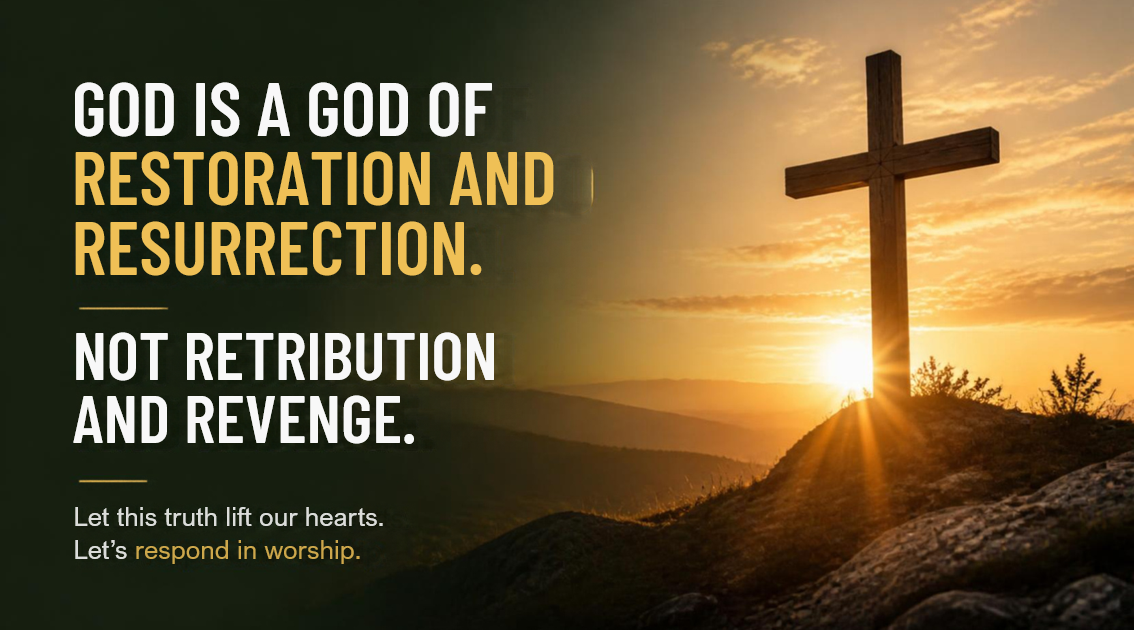
Well, Jesus wouldn’t, for one. But when we think God is on our side—the side of self-righteousness—retributive justice becomes a fan favorite. Every time. But Jesus goes on. “Haven’t you heard about the stone which the builders rejected? It has now become the cornerstone.” The rejected one is restored. God is a God of restoration and resurrection. Not retribution and revenge.
And to be sure he’s heard loud and clear, Jesus makes the connection between the tenants and the leaders who had been put in charge of leading the people of Israel to bear good fruit. He says, “That’s why I tell you that the kindom of God will be taken from you and given to the people who bear the fruit of God’s vineyard.” Because the leaders had lost site of their mission. Their purpose from God—to produce good fruit.
That’s why Isaiah says that the vineyard will be left to rot and become overgrown, without protection from the wilderness. God allowed Israel to be taken over by various empires. If they wanted to behave like other nations, they could find out what it meant to live under the rule of other nations.
That’s why the first humans were sent away from the beautiful garden built for them. They wanted to be gods, themselves. They did not trust the one who provided for them. They only trusted themselves, so God allowed them to find out what it looked like to provide for themselves.
But even after all that, even after God allows us to experience what it is we ask for over and over again, God has not abandoned us. Sometimes it feels like it. But it’s not God that abandons us. We abandon God. We abandon God in an effort to accumulate power and build empires. We abandon God when we think we can do better than the abundance God provides for us. We abandon God when we decide that the best way to handle things is retaliation.
God is a God of restoration and resurrection. Not retribution and revenge.
I wonder if Jesus began the parable with the option that the bad tenants were, indeed, the empires who historically had oppressed Israel. At least, that may have been part of it. Because he asked the religious leaders what they thought should happen to the tenants. He gave them an option. Should they be like God? Or like the empires?
They could have answered differently than they did. They could have answered with a measure of grace or hope. Of mercy. They could have turned to Psalm 118 and said that God would restore the ones cut down.
But instead, they jumped right to revenge. The landowner shouldn’t just kick them out and replace them. He should kill them. Get them back. And in that answer, they chose their own punishment. They chose revenge over redemption. They chose to be like the empires of oppression. Rather than recognizing Eden, they chose hell, all the while thinking that God was on their side.
That’s the danger, isn’t it? That’s the danger of being so ready to take control, to be in charge, to grasp at power. How quickly we jump to revenge when we experience hurt, pain, or grief. When the world isn’t as it should be. Rather than leaning harder on grace and hope, we go dark. ‘Get them back. Get them first. Get them all.’
That’s what is so dangerous about concepts such as Christian nationalism. When we mistake the God of refuge, the God of reconciliation, the God of resurrection and restoration for a God of unfettered power, revenge, and bitterness. It’s a corruption of Scripture. It’s a corruption of grace. And it is anything BUT Christian.
Because Christ never seeks revenge. Even on the cross, Jesus forgives. And only after the empire’s revenge is complete and the son has been killed and cast out of the vineyard does God express the fullness of God’s power. Resurrection. Life. Love Eternal.
Pastor Tobi White
Our Saviour’s Lutheran Church
Lincoln, NE