“A Message of Hope”
Celebration of Epiphany
January 4, 2026
Isaiah 60:1-6
Matthew 2:1-12, 16-18
Children’s Message:
Message in a bottle—getting God’s message out to the world (GPS—Global Positioning Star)
Have you ever heard of sending a message in a bottle? It’s part of stories where maybe someone is stranded on an island. I don’t know where they get the bottle or the paper—or the pencil. But they write a message for help, put it in the bottle, cork it, and toss it out into the ocean. And then they wait for someone to find the message and rescue them.
It’s not a very efficient way to get a message out, is it? What are some ways we send messages? (email, social media, text, phone, letter, postcard, gift). How do you tell someone that you’re there to support them? (hug, hold hands, light candle). Or how do you tell lots of people about something exciting? (Milestones, yell from mountaintop, do a dance).
God wanted to tell the world that something special had happened. And God used a star. That’s a message the people who study stars would understand. Astronomers from far away saw the star, compared charts, watched the skies, and then began a long journey. The star led them to Israel. To Jerusalem. And eventually to Bethlehem. Is a star a very efficient way to send a message? Maybe not, but the message was made for people who study stars. God’s message to us speaks to us in ways we can recognize—a hug from someone we trust, a flower blooming in our path, a smile from a friend, a really neat passage in a book.
All of these messages tell us something very important: they tell us that God is with us. So I have messages for you—in a bottle. For you to remember that God is with you.
Let’s pray. Dear God, you speak to us in different ways to tell us you are with us. Open our eyes and ears and hearts to hear your message. Amen.
Message:
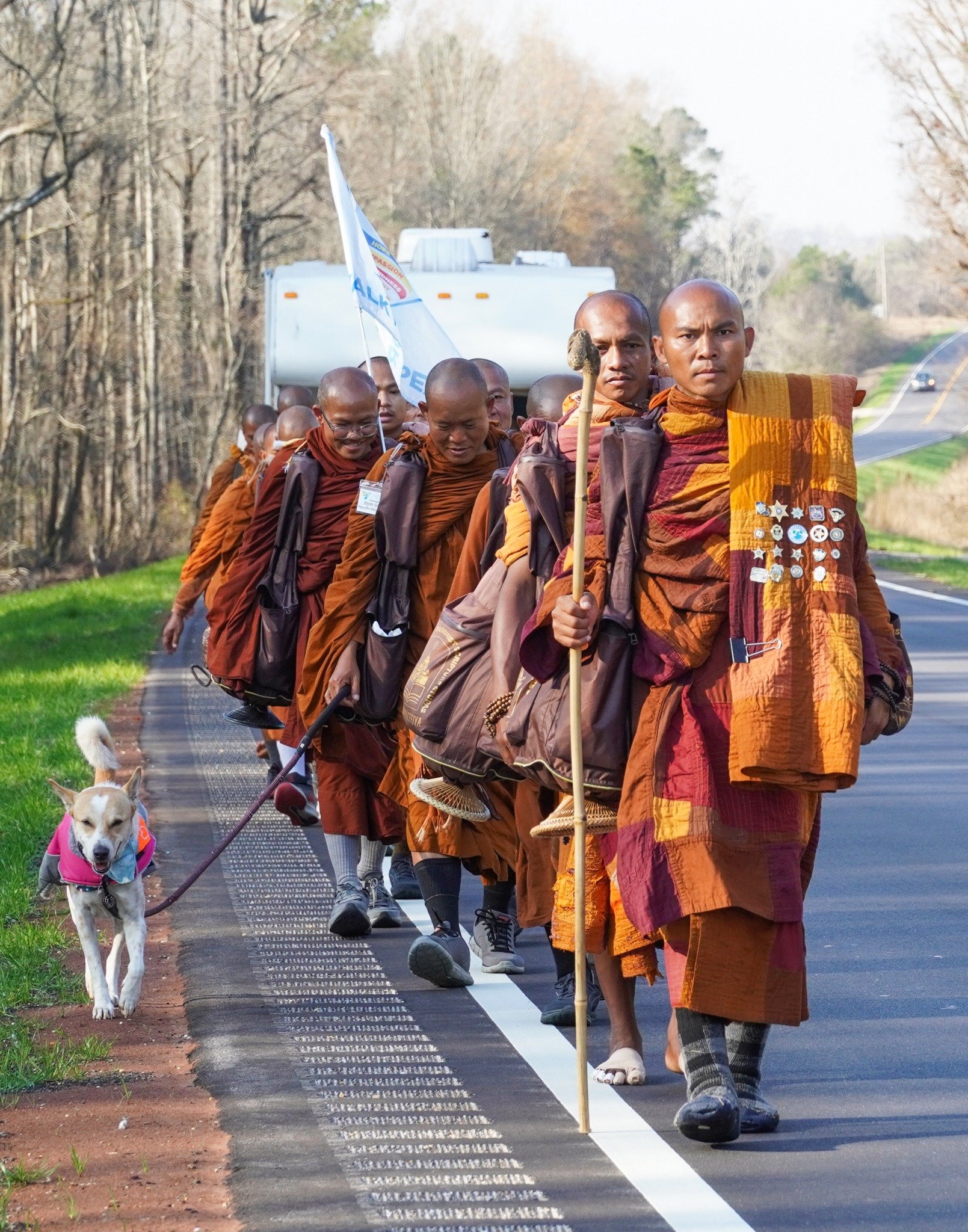
On October 26, two dozen Buddhist monks set out on foot from Fort Worth, TX to make their way the 23,000 miles to Washington, D.C. They discerned the deep unrest and division within the nation and set out to spread peace, compassion, and community. Journeying with their peace dog, Aloka, they continue to practice their faith as they go.
They eat one meal a day, now often surrounded by thousands of people breaking bread together. They walk with intent and prayer and purpose. They practice humility and kindness. Even after two monks were injured in an accident early on and one lost his leg to amputation, he stated that he is not angry. It is a sacrifice willingly given in the work for peace.
They are now on day 71, making their way through Georgia. Streets and highways along the way are lined with people desperate for hope, people who admire their quiet strength, people who see in them a beauty that seems to be lacking in society. They are estimated to reach D.C. sometime in March. A six-month journey filled with prayer and peaceful intent.
I wonder how long it took the magi to reach Israel. It would have been a long journey, as well. By foot or on camels or horses or donkeys. Maybe there were two dozen who made their way across the Middle East. Men and women. Traveling light, making camp outside towns or welcoming invitations from locals. Sharing what led them there and where they seem to be heading—what they hope to find when they finally reach their destination.
It’s a journey that is inspired by hope—a hope that doesn’t quite know, yet, where the journey will lead. Only that it will be worth it. I wonder what the monks will do or what they expect when they reach the capital city. I wonder what kind of response they will get. A welcome similar to Herod’s in Jerusalem? Filled with duplicity and fear? Or one similar to the holy family in Bethlehem, filled with wonder and grace?
Like the monks, the magi pose a stark contrast between their intent and that of the powers that be. The Herods of this world respond to hope and kindness with fear; the magi respond with faith. The Herods respond with resistance; the magi embrace the good news. The Herods see hope as a threat; the magi see it is promise. The Herods are greatly disturbed; the magi rejoice.
And in the end, the magi recalculate their route home. When you experience the beauty of Christ, you simply have no desire to return to Herod. So, I wonder what the monks will do when they reach D.C. Will they go to the White House and dine among the gilded frames and eat with gold-plated cutlery and hear words of bombastic proportions vomited over them?
Or will they sit with the homeless and the hopeless? Will they share their meager meal with the downtrodden and weary? Will they share their peace with those who have been abused? Will they share their welcome with those who fear deportation? Will they be threatened with deportation, themselves?
The magi weren’t Jewish. They obviously weren’t Christian. And yet, their faith allowed them to recognize and proclaim good news, hope, and peace. Their faith moved them across borders to welcome the Christ-child in their own beautiful way. The Buddhist monks aren’t Christian. And yet, their faith is offering a way of peace and hope that many Christians today can’t fathom—or worse, they despise. A way that sacrifices, humbles, and loves without regard to money, race, sex, or language.
In the devotional for this series, Rev. Dr. Boyung Lee says,
While the religious elites remain static, the magi cross boundaries, bow in humility, and respond to revelation. They do what Herod and his allies refuse to do: seek, kneel, and listen.
Epiphanies are not always warm or personal. Sometimes they are disruptive, even dangerous. Sometimes they lead to confrontation with empire. Sometimes they ask us to cross borders. Sometimes they send us home by another way. And always, they ask something of us: Will we move the way fear makes us move? Or will we move the way love calls us to?
Like the magi, these Buddhist monks are offering a light in the darkness. They are practicing beauty in the midst of ugliness. They are sharing with us a tether to the promise God makes with all of creation—that it is good and very good.
Rev. Dr. Lee closes by saying, “In the face of fear, let us travel together. Let us defy empire not with swords, but with solidarity. Let us kneel in awe, not before the powerful, but before the powerless Christ, whose birth marks the beginning of God’s peace campaign. Let us believe, with trembling hope, that fear does not have the last word. Because fear doesn’t stop us. Love leads us forward.”
Fear leads us forward…one step at a time. One message at a time. One meal at a time. One person at a time.
Pastor Tobi White
Our Saviour’s Lutheran Church
Lincoln, NE