“Swords of Justice”
Fourth Sunday after Pentecost
June 21, 2026*
Psalm 46
Matthew 10:24-39
Wonderful Counselor, Mighty God, Prince of Peace, Lord of Life—these are the names we love to use for the Christ. But it is not the description Jesus gives us today. Rather, he says, “I have come not to bring peace, but a sword.” And then he goes on to describe how his message will divide families and destroy relationships.
That’s just not what we expect to hear from the Prince of Peace. It’s not what we expect from the God of Love. Isn’t Jesus supposed to be about uniting the world, healing the world, making us whole—not tearing us apart? Well…yes. He is. And he does do that. But first, the gospel must be proclaimed—the message must be spoken. And, as Jesus exemplifies in his death, that message is not always welcome. His message of love, hospitality, and sacrifice is not easily embraced. And those who embrace it—those who proclaim it—will not always be welcome, either.
Today’s gospel passage comes at the end of Jesus sending the disciples out into the towns and villages. He told them they might not always be welcome and how they are to respond when they are not. He warned them that eventually they will be arrested and beat and killed because of the gospel. And finally, at the end of his teaching, he says, “Whoever does not take up the cross and follow me is not worthy of me.”
What is that to mean when he hasn’t even been crucified yet? What do the disciples hear in those words? They hear a call to stand against the empire—a power that kills people as a warning to get behind the empire. A power that shuts down any resistance to oppression. A power that silences voices of hope—voices that empower the vulnerable and outcast. A power afraid of an uprising.
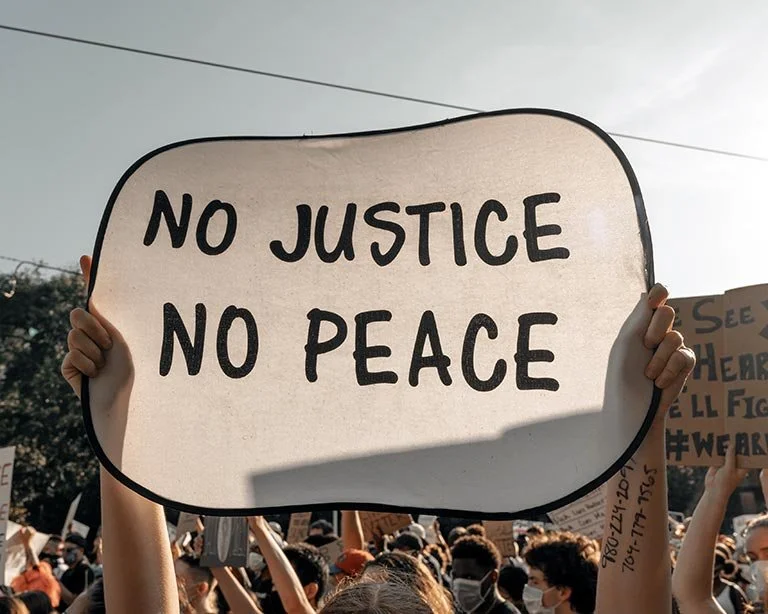
You see, when truth-telling exposes the mighty, peace must wait for justice.
This isn’t exactly the warm and fuzzy gospel we all hope to hear when we come to church. And that’s the whole point. The prophet Micah speaks out against, “The prophets who cry ‘Peace’ when they have something to eat but declare war against those who put nothing into their mouths.” When the world isn’t as it should be, we have no right to rest comfortably within our cozy understandings of faith.
Martin Luther recognized the need to speak the truth of the gospel to an Empire-Church that was oppressing its people. In 1517, he made public 95 statements of opposition that exposed the Pope and the Church of distorting the message of Christ. His work to expose this Truth not only divided his family—it divided his Church. He was excommunicated from the people he loved, forced out of the community that had cultivated his faith. And still, he persisted in his faithful proclamation, nearly getting himself killed multiple times.
When truth-telling exposes the mighty, peace must wait for justice.
Another example is Dietrich Bonhoeffer. Born into a somewhat elite family, he learned a certain amount of national loyalty to Germany, his beloved home. He became a pastor and seminary professor within the Lutheran Church. And as Hitler rose to power, Bonhoeffer began to recognize the power his government had over his church—how discipleship was being undermined by patriotism—how the Savior of the vulnerable and oppressed was being hijacked and made into a symbol of oppression.
I can’t imagine the courage it took to speak against this movement. But Bonhoeffer took steps to establish an underground church and seminary that wasn’t subject to the government’s management. He spoke out against Nazi atrocities over the radio. And in the end he and two brothers-in-law were arrested and killed for plotting against Hitler, himself.
Before his arrest, Bonhoeffer wrote several books, including one called “Life Together.” In it, he speaks about the consequences of the gospel and quotes Martin Luther, himself.
“Jesus Christ lived in the midst of his enemies. At the end all his disciples deserted him. On the Cross he was utterly alone, surrounded by evildoers and mockers. For this cause he had come, to bring peace to the enemies of God. So the Christian, too, belongs not in the seclusion of a cloistered life but in the thick of foes. There is his commission, his work. 'The kingdom is to be in the midst of your enemies. And he who will not suffer this does not want to be of the Kingdom of Christ; he wants to be among friends, to sit among roses and lilies, not with the bad people but the devout people. O you blasphemers and betrayers of Christ! If Christ had done what you are doing who would ever have been spared' (Luther).”
When truth-telling exposes the mighty, peace must wait for justice.
We could probably tell stories of Christian martyrs and prophets all day long—Martin Luther King, Jr., Desmond Tutu, Nelson Mendela, and so many more. But today, I want to point out a non-Christian prophet who stood up to the empire, who nearly lost her life fighting for the oppressed and vulnerable in her community.
Many of you have heard of Malala Yousafzai. She was born in 1997 and as a young girl attended a local school her father founded. Her community had once been a tourist destination until the Taliban took over. They destroyed her town and attacked schools dedicated to educating Pakistani girls. In 2008, at the age of 11, she gave a speech entitled, “How dare the Taliban take away my basic right to education?” In 2009, she began blogging for the BBC about her experience under Taliban rule.
Malala and her family became the target of a death threat put out by the Taliban. On October 9, 2012, while riding her school bus, a terrorist boarded the bus and shot her in the head. She was treated and sent to the United Kingdom to continue her recovery. After several surgeries, she recovered and continued her education and her advocacy. In 2014, Malala was the youngest person to receive the Nobel Peace Prize at the age of 17. And even though the Taliban still considers her a threat and still has a contract out on her, she persists in her proclamation of truth and justice.
When truth-telling exposes the mighty, peace must wait for justice.
In family systems theory, we learn that as soon as one person changes their role in the system, the whole system gets anxious. Maybe it’s an addict who gets healthy, or the peace-maker learns to let her siblings fight it out, or the door-mat stands up for himself. Even the healthiest changes produce anxiety because everyone’s roles get changed. If the symptom-bearer get healthy, the care-taker doesn’t know who they are anymore.
In some systems, the anxiety is too much to bear and eventually everyone goes back to where they were. The recovering addict goes back to the old ways or takes on new habits; the peace-maker can’t stand the division and steps in to mediate; the door-mat doesn’t like being disliked—and the system returns to the way it was. But sometimes, everyone learns a new way of being and, for the first time, experiences peace—peace that comes, not of familiarity of the old, but of experiencing the new. It may only be possible after a divorce, or a change in jobs, or the end of a friendship. It never comes without loss—it never happens without a cross and a death.
When truth-telling exposes the mighty, peace must wait for justice.
Proclaiming the Truth of the cross will always lead to an upheaval of a system, division in relationships, and a challenge of those in power. But the death of Jesus gives us hope—because his death proves that death isn’t the end. His resurrection shows us that the cross we take up is a temporary but necessary part of the process to true peace and abundant life. And his cross shows us, if anything, that the division and difficulties resulting from truthful proclamation aren’t a sign of failure but a sign of faithfulness. If we’re doing what we’re supposed to be doing, this will get harder before it gets better. But the end product, if we are around to see it, will be closer God’s promise of peace, hope, and life.
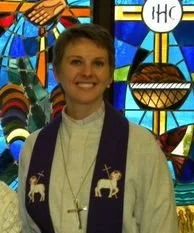
Pastor Tobi White
Our Saviour’s Lutheran Church
Lincoln, NE
*originally preached on June 25, 2017